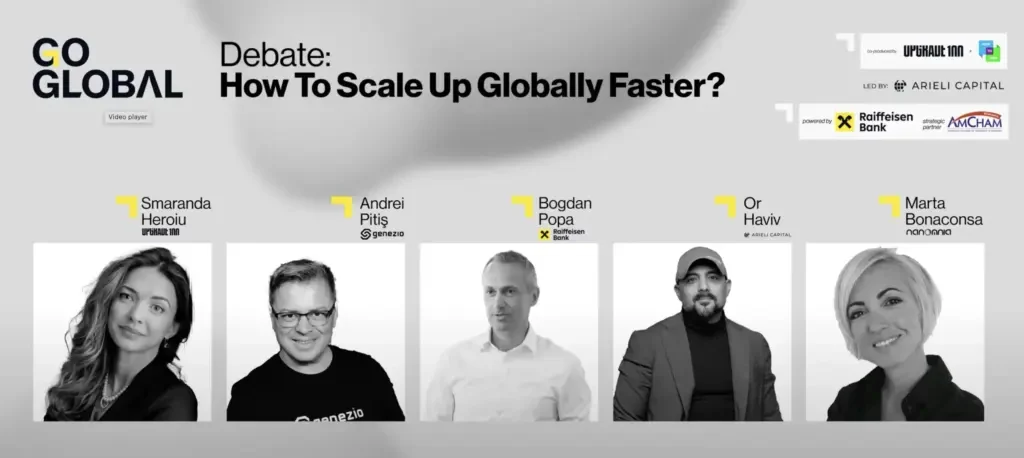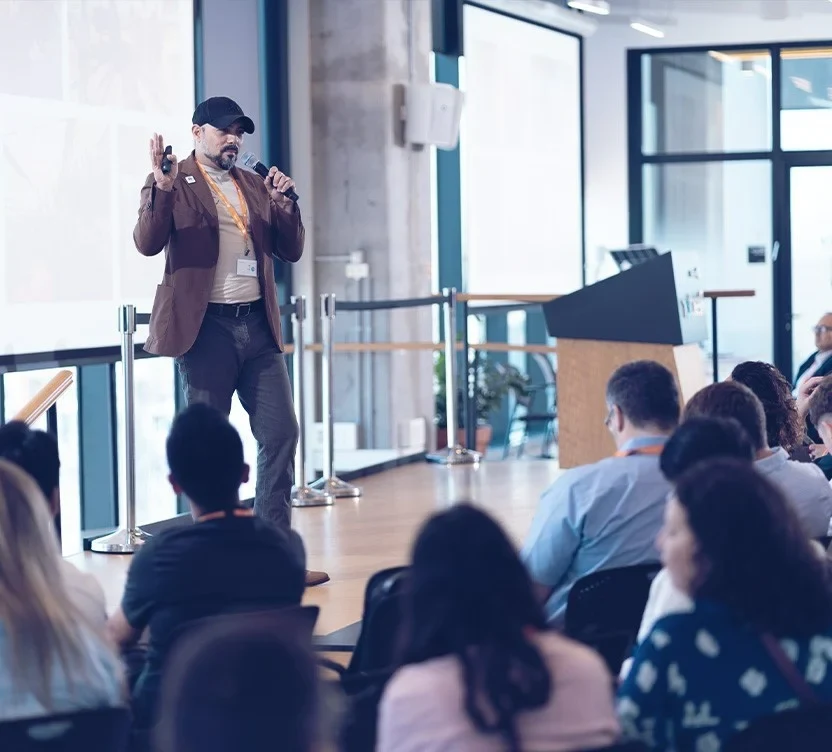
Good news for Romanian startup founders: GO GLOBAL! will launch at How to Web 2024!
An advanced business accelerator aimed particularly at entrepreneurs who dream of global expansion.
The programme already operates in Italy, Slovenia and the US state of Utah. Alongside Romania, it will also launch in the Czech Republic.
- Find more information about programmes in other countries here, and in our launch announcement here.
In Romania, GO GLOBAL! launches through a partnership initiated by Upgrade 100 alongside How to Web, with strategic backing from AmCham—the American Chamber of Commerce—and the support of Raiffeisen Bank Romania.
GO GLOBAL! is an accelerator focused on global expansion, explains Or Haviv, Partner and Head of Innovation at Arieli Capital.
Arieli is a global business with offices in Tel Aviv, New York and London. According to Or Haviv, the company values a long-term vision when partnering with a startup.
“We are marathon runners. Although we may look like sprinters because we are innovators, we look far into the future, not just five to seven years ahead, whether we are talking about people or businesses,” says Or Haviv.
If you have a startup and dream of expanding internationally, our conversation with Or Haviv below will be useful.
It covers what you need to do to access funding, the programme’s vision, what to focus on at this stage and the other benefits available beyond a potential investment.
“Romanians want to know the smart way to fail”
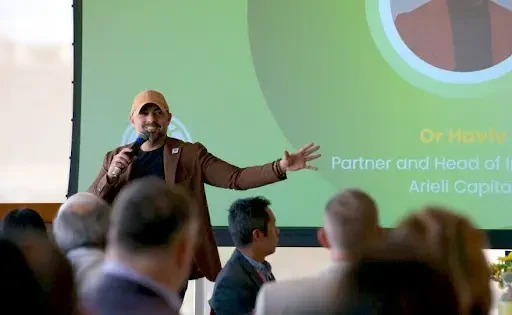
- How many startups will take part in the first stage? Is the focus on technology, or are you exploring other sectors too?
Or Haviv: We will have between 7 and 11 startups per programme. We are interested in diversity, rather than focusing on a single type of startup. As we get to know the ecosystem, we want to offer opportunities to startups at different stages and create value for them.
- What does an ideal applicant for this accelerator look like?
O.H.: The ideal startups are at the seed stage, with a strong team. They should have a working, validated product, not just an idea. Ideally, they already have real users—a hospital pilot, for example—and can show that they have raised money from other investors. Most importantly, they must have global ambitions.
- How does Romania’s business environment differ from other European markets? What advantages and distinctive challenges does it offer?
O.H.: In Romania, we discovered that people want to know the smart way to fail: how to take risks effectively.
We work with many governments, incubators and innovation centres in different countries, and cultural differences always stand out. We generally ask questions about the places where we launch programmes. We want to understand how people in these ecosystems think and which risks they are willing to take.
In some cultures, failure is not permitted.
In Israel and the United States, however, failure is appreciated. People see you as courageous and someone they can learn from. They will invite you to speak at conferences about your experiences.
Technology investors also do not want to invest in what you already have. They want a company that may be worth €1 million today but could reach €100 billion. They invest in dreams.
“Our advice is simple: do not be ashamed to talk about what you do not yet have but dream of creating.”
— Or Haviv, Partner at Arieli Capital
- Why is Romania the next stop for this project?
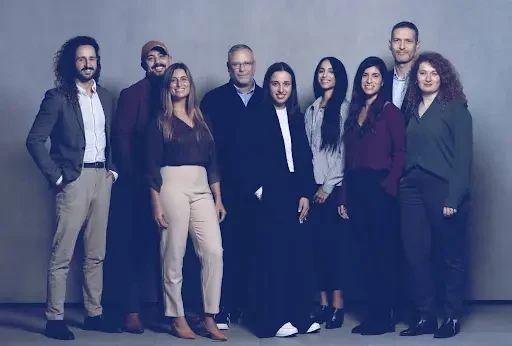
O.H.: The Romanian programme required considerable effort and investment on our part, but it was also a natural step. Doors opened naturally to excellent partnerships.
Our outstanding partners at the Israeli Embassy, AmCham, Raiffeisen Bank, How to Web, Upgrade 100 and others were essential, and that made a significant difference.
We want to make the world better while also generating profit, and both objectives have been achieved.
Romania’s ecosystem is developing, which means there is significant growth potential and many investment opportunities.
Romania has a strong culture, intelligent people, research, technology and entrepreneurship, but its ecosystem is still growing.
“Even if a business fails after five years, it can inspire 100 other startups”
What five things should an entrepreneur keep in mind when trying to expand globally?
O.H.: Drawing on our experience at Arieli, particularly with businesses in Italy and Slovenia that subsequently expanded quickly and sustainably, there are five lessons:
1. It is about revolution, not only evolution.
To be attractive, you should not offer only small, local solutions. Investors are willing to invest at scale and take risks, but the potential must be there. Try to create a revolution, change things and discover enormous potential.
2. Be very practical and specific.
Aim to solve a problem that causes real pain.
3. Validate your idea.
Do not develop projects hidden away in a garage. Go into the real world and test your idea with real users.
4. Make sure you create real value.
Be certain that what you offer is a good business proposition.
5. A startup’s purpose, by definition, is to fail as quickly and cheaply as possible, allowing you, the entrepreneur, to validate what you are doing and discover the next step. The key is to pivot quickly and at minimal cost.
- What is the greatest challenge in going global, and what would make an entrepreneur eventually say that the effort was truly worthwhile?
O.H.: The biggest challenge is understanding that entrepreneurship is about trying, not spectacular exits. It does not matter if you fail; what matters is that you try.
Even if a business fails after five years, it can inspire 100 other startups and train many people. It is about much more than money. It is a global mission, and everyone should be somewhere that pushes them to do something innovative.
“If you go somewhere where people say they know everything, it is not a good place. Romania is open and receptive, which is exactly what we are looking for.”
— Or Haviv, Partner at investment firm Arieli Capital
- As an entrepreneur, what are the main benefits of discovering the business cultures of Israel and the United States?
O.H.: The idea is simple: if you want to learn to make excellent pastries, you go to France, not India. Similarly, the leading ecosystems for producing unicorns per capita are in Israel, Silicon Valley, New York and London. On a per-capita basis, Israel is the best place to learn how to build globally.
The magic of Go Global is that it provides access to the business ecosystem as well as knowledge. Even in weak years, investment in Tel Aviv remained very high.
You need to be where major deals happen, because that environment will influence you positively.
Tel Aviv and New York are also global hubs, attracting people from around the world. In business, you need to be among people with extensive experience, strong networks and an active financial environment. We offer all of these.
Between 2018 and 2022, Israel launched 9,500 technology startups. In 2021 alone—a peak year—these companies attracted an enormous $33 billion in investment.
Why attend the Go Global launch at How to Web 2024 on 2 October, starting at 11:00?
“We are coming to meet courageous, visionary entrepreneurs who want to take their ideas to where they dream of going and turn them into global solutions.” — Or Haviv, Arieli Capital
See the How to Web 2024 agenda here and join the panel organised by Upgrade 100 during the conference.